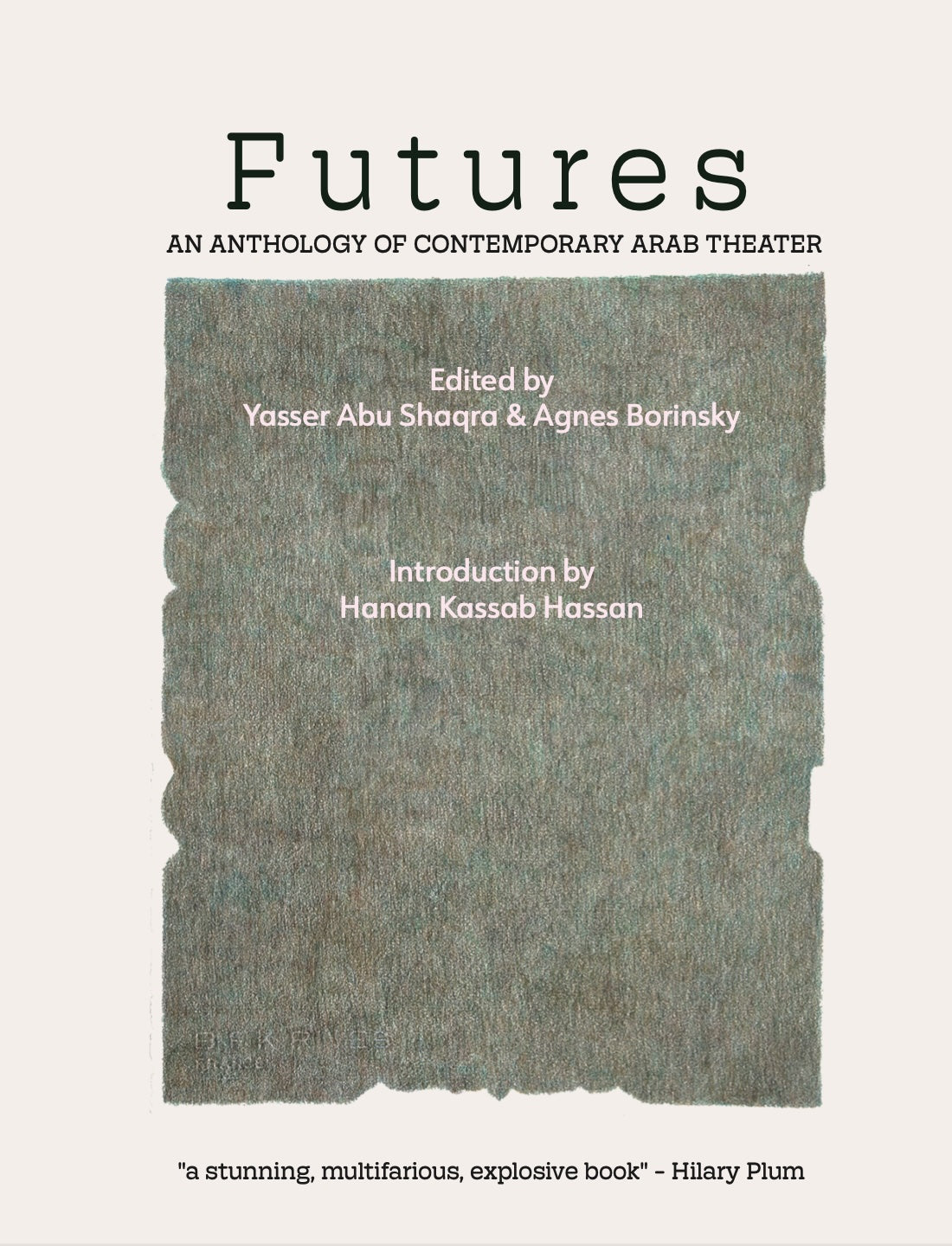
Futures: An Anthology of Contemporary Arab Theater
Futures: An Anthology of Contemporary Arab Theater
Couldn't load pickup availability
FUTURES: AN ANTHOLOGY OF CONTEMPORARY ARAB THEATER
Ed. by Yasser Abu Shaqra and Agnes Borinsky
with plays by Yasser Abu Shaqra, Wael Kadour, Arzé Khodr, Rim Mejdi, Nasr Sami, & Leila Toubel
translated by Hisham Ben Khamsa, Jonas Elbousty, Caline Nasrallah, and Clem Naylor
ISBN: 979-8986581491
December 2025
$25
400 pages
5.5x7.5 inches
An anthology of six new plays written in Arabic, published here in English translation. Including five plays selected from over 500 submissions to Masrah Ensemble’s 2021 Open Call and one by Masrah Ensemble’s former playwright-in-residence, these six texts—by Yasser Abu Shaqra, Wael Kadour, Arzé Khodr, Rim Mejdi, Nasr Sami, and Leila Toubel—represent a diverse array of voices and styles, and push at the limits of theatrical form and public discourse. The volume features an introduction by theater writer/director/academic Hanan Kassab Hassan along with short introductions to the plays by US-based playwrights Lucas Baisch, Jess Barbagallo, Jordan Baum, Agnes Borinsky, Nazareth Hassan, and Haruna Lee.
Sometimes We Remember by Arzé Khodr (Lebanon)
Translated by Clem Naylor, with an introduction by Nazareth Hassan
A Fornesian diamond of a play that unfolds in a series of seemingly simple domestic and urban scenes, about the lure of dwelling in memories of war.
Braveheart by Wael Kadour (Syria)
Translated by Clem Naylor, with an introduction by Lucas Baisch
A play about a group of friends writing a novel together, in which relationships collapse and get rebuilt through the act of writing. How do you move out of a state of war into a time of presumed stability?
Ruby by Leila Toubel (Tunisia)
Translated by Hisham Ben Khamsa, with an introduction by Haruna Lee
A rhythmic monologue, lyrical and dark, in which a woman unpacks a life of misogyny and violence as she prepares to meet her daughter for the first time.
Uprooting; Or, the Cat and Dog Pizza Chapters by Nasr Sami (Tunisia)
Translated by Jonas Elbousty, with an introduction by Jess Barbagallo
A dizzying trip into a world of violence and distortion, by way of the Biblical Song of Songs. In which cats are nailed to walls, and two lovers seek to become one.
Eternity by Rim Mejdi (Morocco)
Translated by Caline Nasrallah, with an introduction by Jordan Baum
A young woman is stuck on a train, and just wants to get off. An allegorical knot of a play that moves between liveness and video, vernacular and formal Arabic, with interludes from Rimbaud's French.
Left Out Gone Bad by Yasser Abu Shaqra (Palestine/Syria)
with an introduction by Agnes Borinsky
A Syrian family arrives as refugees in Europe, where life does not resemble what they imagined. Over the course of the play, each member of the family finds themselves backed deeper and deeper into a corner, and “safety” proves a devil’s bargain.
PRAISE
"These are texts that neither compromise nor seek to entertain; they do not bow to established norms and conventions. They scar because they are truthful, and their impact on the reader, whether through reading or performance, will transcend the old categories of fear and pity, going beyond mere identification or estrangement. They emanate from us and they are for us. They map our own memory, describe our own reality, and express our own pain."
—Hanan Kassab Hassan
"When I finished reading the six plays in FUTURES I felt I’d become a vibrating point in an expanding, impending, defamiliarized world. The six playwrights included—Arzé Khodr, Wael Kadour, Leila Toubel, Sami Nasr, Rim Mejdi, Yasser Abu Shaqra—are each keenly distinct in their work and insight. Gathering them here in translation makes for a stunning, multifarious, explosive book. Displacements, hauntings, authoritarian shadows, linguistic power struggles, families severed and returned, choices and dark absences of choice, mercy and its opposites, remembering and forgetting among ghosts and migrations and others’ dreams… These playwrights (and translators and editors) are preparing their audience, with love and imagination and lucid horror, for our own futures, grabbing our hands as the train picks up speed."
—Hilary Plum, author of State Champ and Important Groups
CONTRIBUTORS
Yasser Abu Shaqra is a Palestinian-Syrian playwright, born in Damascus and a graduate of the Higher Institute of Dramatic Arts. He designed and implemented several interactive theater projects in Damascus and its suburbs. His plays have been published and performed internationally, and a collection of his poetry was released in Denmark. He currently resides in France. He works as the scientific editor of the Theater Section in the Arabic encyclopedia Arabica.
Lucas Baisch is from San Francisco. His plays have been read and developed at the Goodman Theatre, The Playwrights’ Center, The Bushwick Starr, The Mercury Store, First Floor Theater, Cutting Ball Theater, Playwrights Horizons, Clubbed Thumb, The Neo-Futurists, Chicago Dramatists, etc. Lucas is a recipient of a Steinberg Playwright Award, the Princess Grace Award in Playwriting, a Jerome Fellowship, the Kennedy Center’s KCACTF Latinx Playwriting Award, and the Chesley/Bumbalo Playwriting Award. His plays have been published by Bloomsbury/Methuen Drama, Yale’s Theater Magazine, and 53rd State Press. Outside of writing for theatre, his artwork has been presented at Elsewhere Museum, the Electronic Literature Organization, gallery no one, and the RISD Museum. He has held residencies through Ars Nova, Page 73, the Lower Manhattan Cultural Council, ACRE, Elsewhere Museum, Millay Arts, the Wurlitzer Foundation, the Djerassi Resident Artists Program, the Goodman Theatre’s Playwrights Unit, and as a Lambda Literary Playwriting Fellow. MFA: Brown University.
Jess Barbagallo is a theater artist and poet based in New York City. He has been staging his writing for many years with his friends, students, and loves: Grey-Eyed Dogs, Karen Davis Does the Club, Etc., Good Year for Hunters My Old Man and Other Stories, Beaches in Winter, Weekend at Barry’s/Lesbian Lighthouse, Laughing in Los Angeles, and Cemetery Soup. Other directing credits include Pony (Portland Theater Festival), It’s That Time of the Month (Soho Rep, Obie Award - Special Citation), and The Last Podcast on Earth (The Tank). Jess has recently performed in Agnes Borinsky’s The Trees, Amanda Horowitz’s Bad Stars, Jerry Lieblich’s The Barbarians, and Jordan Baum’s 21st Century Princess. He considers himself a proud member of a community of stage-makers who push against theatrical norms to reflect life in 2025.
Jordan Baum writes and makes theater. Most recently, he wrote and directed 21st Century Princess, which was performed at Pageant In NYC in 2025.
Executive Director of EnviroFest and President/Founder of Tunisia Cinema Foundation, Hisham Ben Khamsa is a cultural activist, specialist in communication and cinema and a veteran of the Tunisian, Arab and African film industry. For many years and until 2019, he was the communication director of the Carthage Film Festival JCC. In 2007, he founded the Tunisian Cinema Pavilion at the Cannes Film Festival on behalf of the Tunisian Ministry of Culture. Hisham is also a translator and subtitler from and into English, French and Arabic of Tunisian and international films selected and awarded at the biggest festivals in the world, Cannes, Venice, Toronto, the French Césars and the Oscars. He has previously collaborated with Leila Toubel, translating two of her plays.
Agnes Borinsky is a writer, performer, and convener of people. Her plays include The Trees, A Song of Songs, Of Government, Ding Dong It’s the Ocean, Brief Chronicle, Books 6-8, and Lost Tribe. Participatory projects include: Working Group for a New Spirit and Weird Classrooms. With Paul Spera, she is co-custodian of Masrah Ensemble.
Jonas Elbousty holds an MPhil and a PhD from Columbia University. He is an academic, writer, and literary critic and translator. He teaches in the Department of Near Eastern Languages and Civilizations at Yale University. He is the author or co-author of nine books, including Faces (Georgetown University Press, 2024), Reading Mohamed Choukri’s Narratives (Routledge, 2024), The Screams of War (Seagull Books, 2024), Tales of Tangier (Yale University Press, 2023), Aswat Mu’asira: Short Stories (Georgetown University Press, 2023), Vitality and Dynamism: Interstitial Dialogues of Language, Politics, and Religion in Morocco’s Literary Tradition (Leiden University Press, 2014). He is the book series editor of the Cultural Production on the Middle East and North Africa, and editor in chief of the Journal on Maghrebi Studies. His forthcoming books are Zoco Chico (Georgetown University), The Routledge Handbook on Cultural Production in the Middle East and North Africa (Routledge), and Exploring Contemporary Arabic Novels (Routledge).
Since she earned her PhD in theatre from the Sorbonne-Paris (1982), Hanan Kassab Hassan has been a tenured professor at the Damascus University in Syria, in addition to several professorships in the Higher Institute of Dramatic Arts (HIDA) in Damascus, and in the Saint Joseph University in Beirut (IESAV). She was the General Manager of the Damascus Opera House, the General Secretary of Damascus Arab Capital of Culture 2008, and the Dean of the Higher Institute of Dramatic Arts. She was also a member of the “Conseil Cuturel de l’Union Pour la Méditerranée” in France, and an external evaluator for cultural projects presented to the IFPC, UNESCO, the Kuwait Prize, and the Doha Drama Writing Award. She was chosen as an individual consultant for the Intangible Cultural Heritage Section of UNESCO (2016). She has directed theatre plays, managed workshops on dramaturgy, and written many research papers in the fields of theater and the arts. She translated from French into Arabic and vice versa several essays, novels and theatrical texts. She is co-author of the Dictionary of Terms and Concepts of Drama and Performing Arts, which is one of the main references in the field of theatre in the Arab world.
Nazareth Hassan is an interdisciplinary artist working in performance, writing, music, video, and photography. Recent performance works include Untitled (1-5) at The Shed (text published by 3 Hole Press), VANTABLACK at Theatretreffen Stuckemarkt in Berlin, Slow Mania 009 at Center for Performance Research in Brooklyn, and Memory A at Museo Universitario del Arte Contemporaneo in Mexico City. Their first collection of poetry and photography Slow Mania will be published in 2025 by Futurepoem. They have released 4 singles, available on all platforms. They were the 2022 resident dramaturg at the Royal Court Theatre in London. They are a 2023-25 Jerome Hill artist fellow, and a current resident of the Vineyard Theatre.
Wael Kadour is a Syrian playwright and director based in France. He wrote and directed the play “Chapitre quatre”, in the official program of the 2025 Avignon Festival. In the same year, he presented “Braveheart” at the Theater an der ruhr in Germany and Choisy-le-Roi in France. He has been the artistic director of the Ma’louba Theater Collective since 2022, where he has produced and participated in several plays, including “The Long Shadow of Alois Brunner”, directed by Omar Elerian, which opened at the Euroscene Festival in Leipzig in 2023, and “Up There” at the Theater an der ruhr and Theaterhaus Jena in Germany. His plays have been presented in Italy at the Naples Festival, the Kunstfest Weimar in Germany, and Les Vagamondes Mulhouse Festival in France, in addition to Egypt and Lebanon. He has participated as an artistic collaborator and facilitator in several theater labs, workshops, artist residencies, and theater readings in Europe, the United States, the Arab region, Africa, and the United Kingdom.
Arzé Khodr was born in Beirut, Lebanon, in 1976 and graduated in Theatre Studies from Saint Joseph University (Beirut) in 1999. She is a playwright and has worked as a writer and content creator for television since 2005. Her first play, The House (2008), was translated from Arabic and published in English and French. It was performed in German at the Zimmertheater in Tübingen, Germany, in 2014. In 2018, The House was staged in Beirut, where Khodr won the award for Best Playwright at the Lebanese National Theatre Festival. In 2023, her play The Smell of Jasmine was selected as the Middle East regional winner of the BBC International Radio Playwriting Competition.
Haruna Lee is a Taiwanese/Japanese/American theater maker, screenwriter, educator and community steward. Plays include War Lesbian, Memory Retrograde, plural (love) and Suicide Forest for which they received an Obie Award for Playwriting and Conception and was on the 2020 Kilroys List. Lee has received the Steinberg Playwright Award, the Ollie New Play Award, FCA Grants to Artists Award, a MacDowell Fellowship, the Map Fund Grant, and is a member of New Dramatists. Their writing has been published by 53rd State Press, Theater Magazine, Table Work Press and Almanac, and they’ve taught playwriting and theater at Brooklyn College, Stanford, NYU, Pace, and York College.
Rim Mejdi (b. 1989, Marrakech) is a Moroccan filmmaker, theatre director, and curator. Her work unfolds across cinema, performance, and visual arts, weaving together narratives that explore intimacy, adolescence, and the body in moments of transition. Through these themes, she investigates how personal experiences resonate with collective histories.
Her artistic research extends to the urban and peri-urban landscapes of Marrakech and its surroundings, which she approaches as body-territories marked by rupture and transformation. These spaces become central to her reflections on memory, nature, and the imprint of capitalist hegemony, manifested through tourism, gentrification, and extractivism. Working fluidly between film, photography, and performance, Mejdi develops a practice attentive to both individual and communal experience. Her projects seek to map fragile thresholds—between childhood and adulthood, private and public, body and territory—while engaging with contemporary artistic and cinematic practices in Morocco and beyond.
A Tunisian novelist, poet, visual artist, and researcher, Sami Nasr won the 2015 Sharjah Novel Award for Tales of Jaber the Shepherd (Waraq Publishing House, UAE, 2014) and the 2017 Katara Novel Award for The Human Bird (Katara Books, Qatar, 2018). He was shortlisted for the Ghassan Kanafani Novel Award for Barlatras (2024) and the Golden Narrative Award for his short story collection The Assassins (2024). He is founder and editor-in-chief of the peer-reviewed quarterly Al-Shair Magazine. An internationally accredited narrative trainer and supervisor of the “Workshop” short story project, he has published nine books of poetry, five novels, one play, three books of criticism, and two poems in two multilingual anthologies. His research and creative writing focus on oral narratives, exploring their potential and energy within his fictional worlds.
Caline Nasrallah is a literary translator, editor, and researcher based between Montreal and Beirut. Her extensive editing and translation work spans fiction and non-fiction. She has been published with Syracuse University Press, Wasafiri, Interlink Publishing, and more.
Clem Naylor studied Arabic at Oxford University and at Damascus University. He started translating plays for the Royal Court Theatre in London in 2008 and has continued to translate Arabic plays on and off since then, including the works of Mohammad Al Attar, Dalia Taha, and Arzé Khodr. Alongside his translation work, Clem’s work as a British diplomat has taken him to Cairo, Bamako and Berlin.
Leila Toubel is a self-taught Tunisian actress, playwright, director, and activist, recognized as one of the leading figures of Tunisian theatre. Born in 1962 in Hammam-Lif, she worked for twenty-five years alongside Ezzeddine Gannoun, notably as Artistic Director of El Hamra Theater. In 2014, she founded Resist’Art and later launched Dreams Chebeb, a support program for young creators in Tunisia. Her acclaimed trilogy — Solwen, Hourya, and Yakouta — as well as her latest play Ad Vitam (2025) blend poetic imagery with social engagement, exploring memory, life and death, human fragility, and freedom. Known for her uncompromising stance against obscurantism and violence, particularly towards women, she embraces a profound connection with the Tunisian dialect, expressed through a raw, deeply emotional writing style. She has performed on stages around the world, from Tokyo to Montreal. For Toubel, theatre remains “the greatest and shortest love story between an actress and a spectator—divine, ephemeral, and eternal.”
Share